
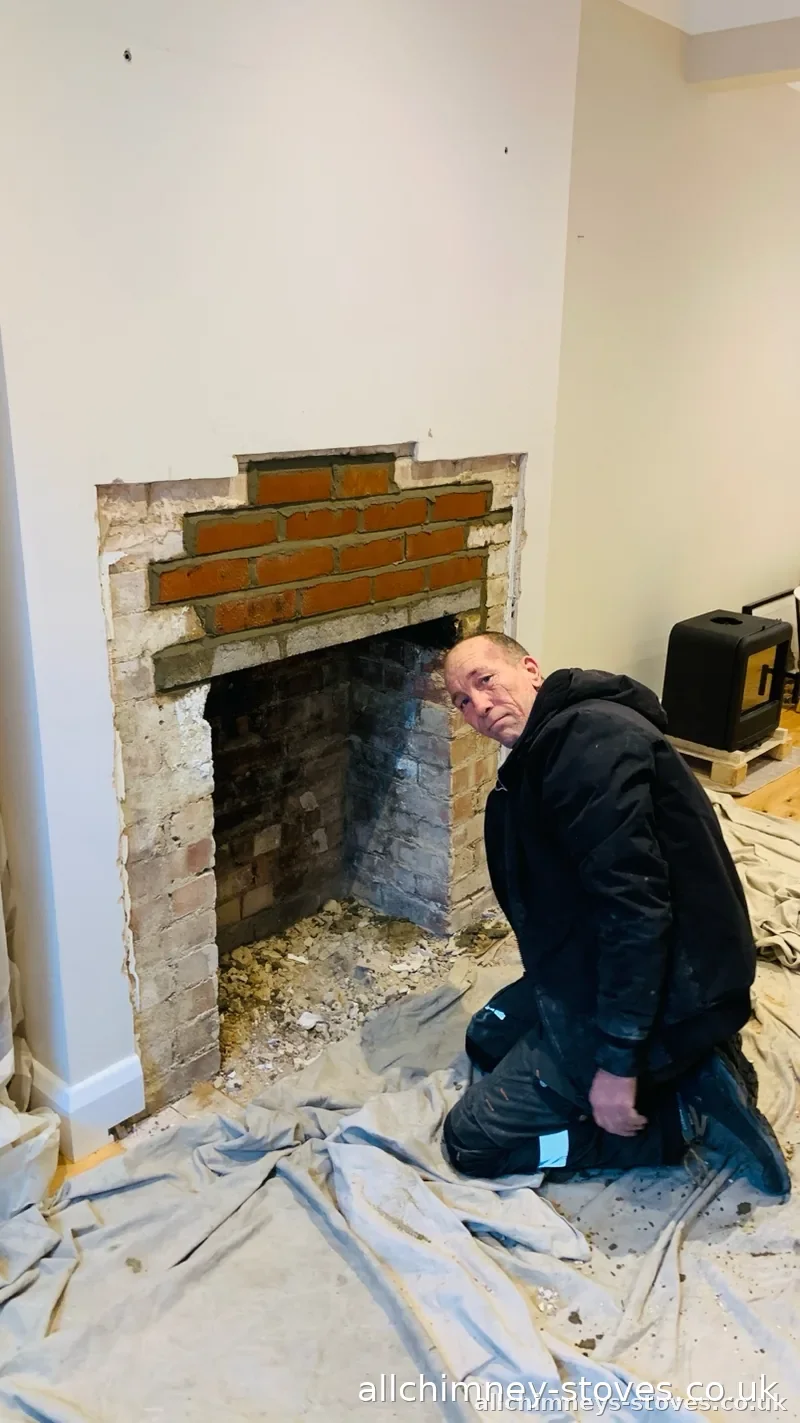
Wood Burning Stove Installation — All Types, All Scenarios
Straight install into a ready fireplace. Gas appliance removal and conversion. Full fireplace reinstatement from blocked or bricked-up. Freestanding twin wall with no existing chimney. One installer. HETAS certified on every job.
What a proper stove installation actually involves
In a simple case — existing chimney, correct opening, right hearth — a stove installation is straightforward. Most cases are not simple. The chimney probably needs lining. The hearth may be the wrong size or wrongly constructed. The fireplace opening may need adapting. There may be a gas appliance to remove. The property may be in a smoke controlled area.
Before anything goes in, we sweep the flue, smoke test it, check the hearth and assess the chimney structure. If something is not right, we tell you before we start — not after. Not buried in the small print after you have committed. Before.
Every installation is HETAS certified. We notify building control on your behalf. Your insurer will ask for that certificate — and if there is not one, a claim relating to the stove may not be covered.
Tier 1 — Your fireplace is ready. The stove goes straight in.
This is the clean version. Existing chimney, opening that takes the stove, hearth that meets regulation. We sweep the flue, carry out smoke tests one and two under Building Regulations Part J, drop in a 125mm Class 1 316-grade stainless flexible liner from pot to register plate, connect the stove and commission it. Two half-days and you have a working, certified installation. Common in Rise Park Romford where the original 1930s chimney stacks are typically in good structural condition.
We split it into two visits deliberately. Day one: liner and all chimney product pot to register plate. Day two: stove installed and commissioned. If anything unexpected turns up in the flue on day one — and sometimes it does — it gets dealt with before the stove arrives. Not discovered after it is already in the room.
- Pre-installation flue sweep and smoke tests 1 and 2 (Building Regulations Part J)
- 125mm S/S Class 1 316-grade twin wall flexible liner — pot to register plate
- Mild steel register plate, flex-to-stove-pipe adaptor
- Rain cap, bird guard mesh, adjustable S/S stove pipe connection
- CO alarm and chimney data plate (Building Regulations requirement)
- Stove commissioned. Site left clean and tidy.
- Customer handover — we walk you through operating the stove, which fuels to burn, how to store fuel correctly, and when to arrange annual sweeping and maintenance.
- HETAS certification issued. Building control notified on your behalf.
Straight installs carried out across Romford, Rise Park Romford, Hornchurch, Gidea Park Romford, Upminster, Emerson Park, Collier Row Romford, Harold Hill, Harold Wood.
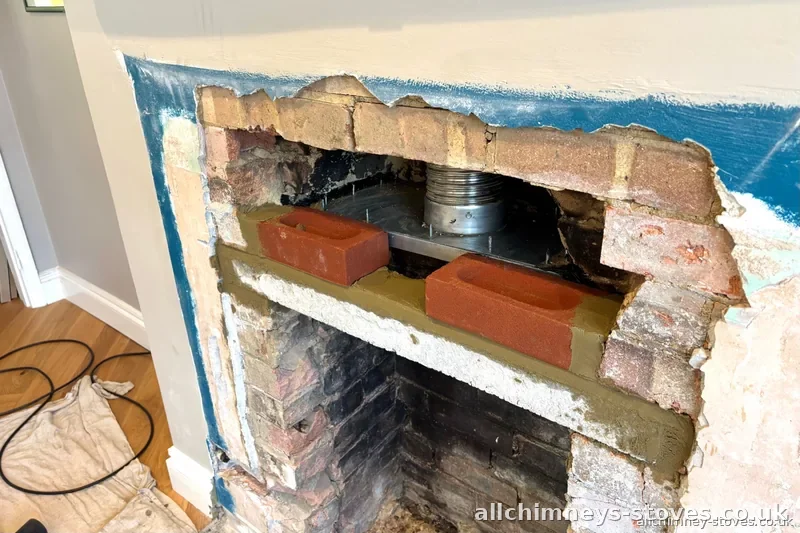
Register plate and 125mm flexible liner installation in progress — fireplace opened, ready for stove. HETAS certified, Collier Row Romford.
Not Sure Which Stove to Buy?
We do not supply stoves and we do not earn commission on what you buy. Send us your shortlisted options before you order. We check: DEFRA-exempt status, kW output for room size, 125mm collar, hearth temperature rating, and ventilation requirements — depending on the property's air tightness and stove output, a permanent air vent may be required under Building Regulations. No charge. Straight answer.
For properties in smoke controlled areas — the Borough of Havering is partially smoke controlled — the stove must be DEFRA-exempt regardless of output. We confirm this as part of every pre-installation assessment.
Send Your ShortlistTier 2 — Your fireplace needs adapting before the stove goes in.
The fireplace is there, the chimney is sound, but there is work to do before a stove can go in. Gas fire still in place. Hearth too small for the appliance. Surround that needs to come out. Opening that needs opening up. This is a modified install — it takes longer and involves more trades, but it is still one contract.
If there is a gas appliance in the fireplace, you do not need to arrange your own Gas Safe engineer. We do that. They come in, disconnect the supply, cap it and sign it off. We attend site after that and the rest of the installation proceeds from there.
- All Tier 1 works included
- Gas appliance removal — Gas Safe engineer coordinated (customer confirms capping before works begin)
- Removal of existing solid fuel fireplace or decorative surround where required
- Removal of Victorian cast iron fireplace where required
- New hearth: minimum 225mm projection, correct construction — screeded and levelled
- Plastering inside chimney breast opening: corner bead, render to opening faces. Decoration by others.
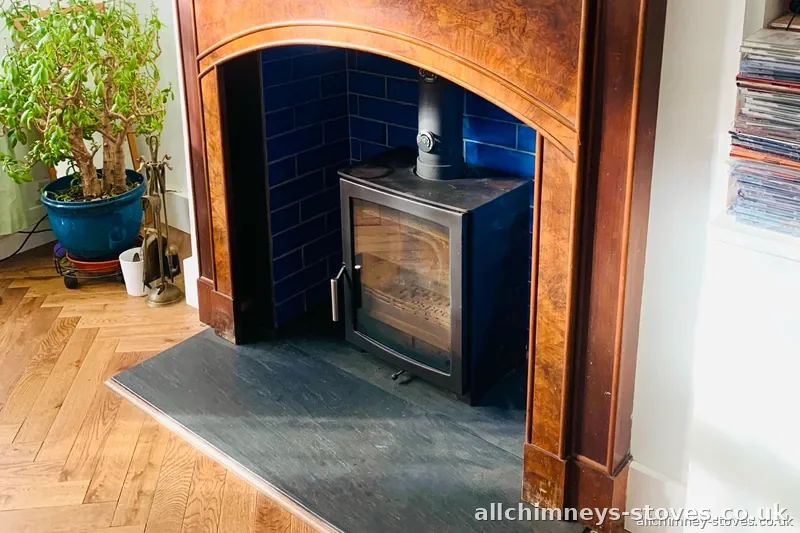
Completed modified installation — gas appliance removed, period arch retained, new slate hearth, blue metro tiles. 125mm liner, register plate, CO alarm. HETAS certified, Hornchurch.
Recent job — Hornchurch, Feb 2026
Gas fire and surround removed. Gas Safe engineer in first to cap the supply. Builder's opening cleared and levelled. 125mm liner, register plate, CO alarm installed. Hearth screeded. Inside of opening plastered ready for client decoration. Client chose period arch surround with blue metro tiles and slate hearth — the finish is entirely theirs, the installation underneath is ours. HETAS cert issued on completion.
Modified installs carried out across Hornchurch, Romford, Upminster, Collier Row Romford and Harold Wood.
Tier 3 — The fireplace has been closed, converted to gas, or blocked. We open it up.
This is the most common job we do in Romford and Havering. Properties that had working chimneys and open fires in the 1970s and 80s. Gas fires were put in. The original fireplace was boarded over or the opening was reduced. The chimney was capped or lined for gas.
We reverse that. The gas appliance comes out — Gas Safe engineers cap the supply. The original builder's opening is reinstated. The chimney is lined for solid fuel. A new hearth is laid. We plaster the internal opening and chimney breast surround. The client decorates. Then we come back and install the stove.
- Gas appliance removal (Gas Safe coordinated) OR Victorian cast iron fireplace removal
- Reinstatement to original builder's opening
- 125mm solid fuel liner installed
- New hearth to building regulation specification
- Plastering: internal opening and chimney breast. Client decorates.
- Return visit: stove installed off crate and commissioned
- HETAS certification issued. Building control notified.
The process runs in two phases with the fireplace opening yours to decorate in your own time between them. When you are ready for the stove, we come back.
Full conversions carried out across Romford, Rise Park Romford, Hornchurch, Emerson Park, Collier Row Romford.
Opening a Bricked-Up Fireplace
Opening a bricked-up fireplace reveals the original builder's opening — the full-size brick cavity behind the blocking. In most cases this is in good structural condition. We reinstate it, test the chimney above, line the flue, lay a new hearth, plaster the opening and chimney breast surround.
Before any opening-up works begin, we confirm the chimney above is serviceable. We do not open up a fireplace and then find the chimney above is unusable — we check first.
Where the original soldier course brickwork above the opening is damaged or structurally unsound — common in properties where a gas appliance has been running for decades — we install a concrete lintel as part of the structural preparation works before the liner and stove go in.
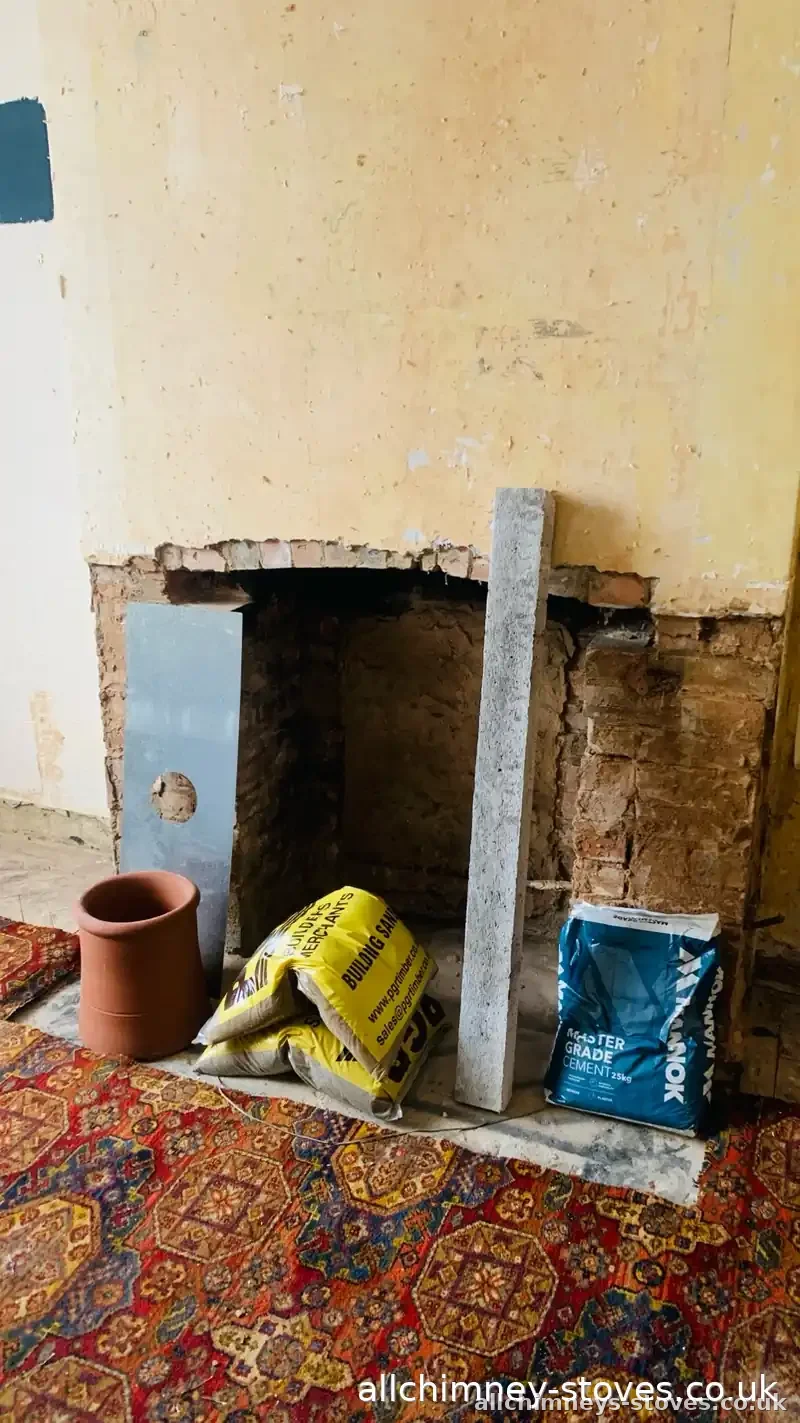
Builder's opening fully reinstated and register plate fitted — fireplace conversion ready for stove. HETAS certified, Emerson Park.
Tier 4 — No chimney. No problem. Twin wall from the stove through the roof.
New builds and extensions do not always have chimneys. A ground floor rear extension with a flat roof is the most common scenario. We install a complete twin wall insulated flue system from the stove up through the roof.
The best time to do this is during the build, while the ceiling and roof are open. We install the flue as a first fix — the builder continues around it, boxes it in, and we return to connect and commission the stove when the build is complete. If the extension is already finished, we open the ceiling and roof — our roofer handles the penetration and weathering. Twin wall first-fix work is common across Gidea Park Romford, Harold Wood and Emerson Park where rear extensions are increasingly common.
There are three possible flue routes depending on the property. First, through a single-storey extension flat roof — the most common scenario. Second, rising internally through the house from ground floor, through first floor and terminating through a pitched roof — the right route where the stove sits in the main house rather than an extension. Third, through an external wall and fixed up the outside of the building to roof height termination — the practical choice where an internal route through upper floors is not possible.
- 125mm twin wall insulated S/S, matt black, G50 rated — 50mm from combustibles
- Black stove pipe from stove collar to twin wall entry
- Joist support plate with ceiling rose at first floor level
- Flat roof weathering plate or rafter bracket to suit roof type
- Industrial locking bands above roof level
- Solid fuel cowl with bird guard at roof termination
- External route available: exits through wall at 45°, 135° tee at base, rises up external face
- Roofer available for all roof penetration — covered under one contract
- HETAS certification issued
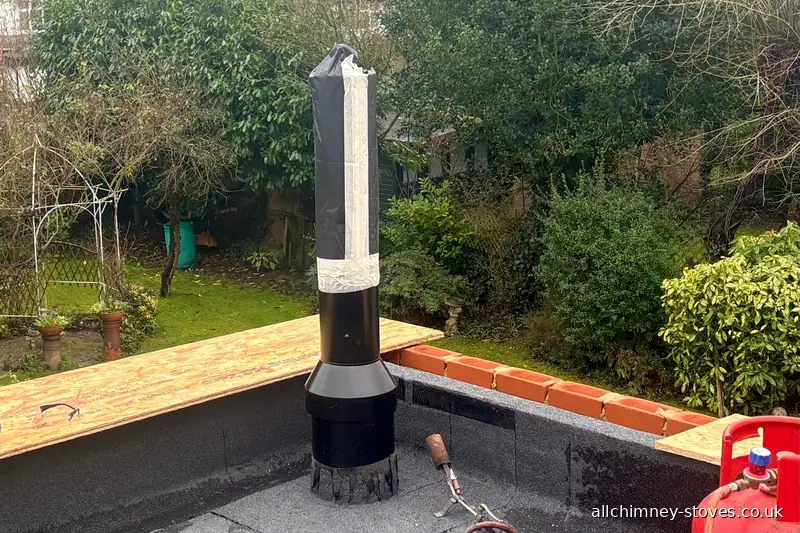
Twin wall first fix through flat roof extension — 125mm insulated flue installed, weathering plate being torched off. Flue extended to termination height and solid fuel cowl fitted on second visit. HETAS certified, Gidea Park Romford.
Real job — Gidea Park Romford
5kW Woodwarm Fireview. Twin wall installed as a first fix during a rear extension build — flue in while the roof was still open, builder continued around it and boxed it in. The photo shows the weathering plate being torched off before the cowl goes on. We returned once the build was complete to extend to termination height, fit the solid fuel cowl and commission the stove. HETAS cert issued on completion.
Twin wall installations carried out across Gidea Park Romford, Harold Hill, Harold Wood, Upminster and Emerson Park.
What HETAS certification means for you
A HETAS certified installer is a competent person under the building regulations. We can self-certify the installation and notify building control on your behalf — no separate building regulations application required. The HETAS certificate we issue at completion is the evidence that the installation meets Building Regulations Part J.
Installing a stove without HETAS certification means the installation is unregistered. Many home insurers will not cover an unregistered solid fuel appliance. If a claim arises relating to the stove, they will ask for the HETAS certificate. If there is not one, you may not be covered.
Craig Hunter has held HETAS registration since 2003. Company registration 6943. Installer registration 23592. A 23-year HETAS registration is rare — and it is on the certificate you receive when the job is done.
Stove Installation FAQ
Do I need HETAS certification for a stove installation?
Yes. Building Regulations Part J requires HETAS notification for all solid fuel appliance installations. Allchimney Stoves issues HETAS certification and notifies building control on your behalf. Your insurer will require this certificate — without it, a claim relating to the stove may not be covered.
Does my chimney need lining?
For a wood burning stove, yes — in virtually every case. A standard brick chimney runs at roughly 9 inches square internally. The collar on a modern stove is 125mm. Connect a stove directly to a 9-inch unlined flue and the gases cool too fast, they condense, and you get tar and creosote building up in the brickwork. Draw will be poor and the risk of a chimney fire goes up. A 125mm liner gives the gases the right velocity to carry cleanly out of the building. It also isolates the flue from the original brickwork — which in older properties often has cracked mortar joints, gaps at floor levels, or deteriorated render. One exception: a purpose-built Class 1 masonry flue of the correct internal diameter, in confirmed good condition, can be used unlined. We test for this. If it applies to your chimney, we will tell you. If it does not, we will tell you that too.
What is a register plate and do I need one?
A register plate is a steel plate that seals the fireplace opening above the stove. It closes off the original throat — the point where the chimney narrows above the open fire cavity — and passes the liner through a central aperture. Without it, cold air cascades down around the liner, draw is poor and the stove is harder to light and control. The register plate is standard on every lined installation we carry out.
Wood burning stove or multifuel — what is the difference?
This is one of the most badly answered questions in stove shops, because the answer affects which stove you buy and therefore the commission earned on the sale. So here it is without commercial bias. A wood burning stove burns seasoned hardwood only. It is optimised for wood — the air wash system, the base design, everything. Wood burns best on a shallow bed of ash, and a wood burner is designed to keep that ash in place. A multifuel stove has a raised grate and an ashpan below it. Smokeless fuels need air from underneath the fire to burn correctly — that is what the raised grate provides. If you are burning seasoned hardwood only, a dedicated wood burner is the better appliance. If you want the option of smokeless coal as well, or you are not certain about your fuel supply long-term, go multifuel. Both types are available DEFRA-exempt for smoke controlled areas.
What output stove do I need for my room?
Rule of thumb: 1kW per 14 cubic metres for a well-insulated modern property, 1kW per 10 cubic metres for an older property with more heat loss. For a typical Romford or Havering semi — say 4x5 metres, standard ceiling height — 4kW to 5kW is the right range. Larger rooms, open-plan spaces or period properties with high ceilings and more heat loss may need 6-8kW. Here is the important part: do not overspec. A 12kW stove in a room that needs 5kW will run permanently on a low air setting to stop the room overheating. Low air settings mean poor combustion, more emissions and more soot and tar building up in the flue. A correctly sized stove runs at its designed operating temperature and performs efficiently. If you are not sure, send us the room dimensions before you order.
Can I keep my existing gas fireplace opening?
In most cases yes. The opening is adapted to suit the stove — a gas appliance is removed, the supply is capped by a Gas Safe engineer (we coordinate this), and the installation proceeds from there. We assess the opening dimensions and hearth on site visit before confirming scope.
Do I need a new hearth?
Depends on what is already there. The hearth must extend a minimum of 225mm in front of the appliance and 150mm to each side. It must be of non-combustible construction to a minimum depth of 125mm where it sits on a combustible floor. Many existing hearths in Romford and Havering properties are either too small, laid too thin, or were installed for open fires and are not correctly specified for a closed appliance. We check on site and advise. Where a new hearth is required, we include it in the installation.
Do I need planning permission for a stove?
Usually no. Twin wall and external flues in conservation areas may need prior approval. We advise on a case by case basis once we know the property and route.
Stove Installation Across Romford & Havering
We carry out all installation types across Romford and the surrounding Havering area. Select your location for local information.
Also covering parts of Brentwood and Chadwell Heath — call to confirm your location.